
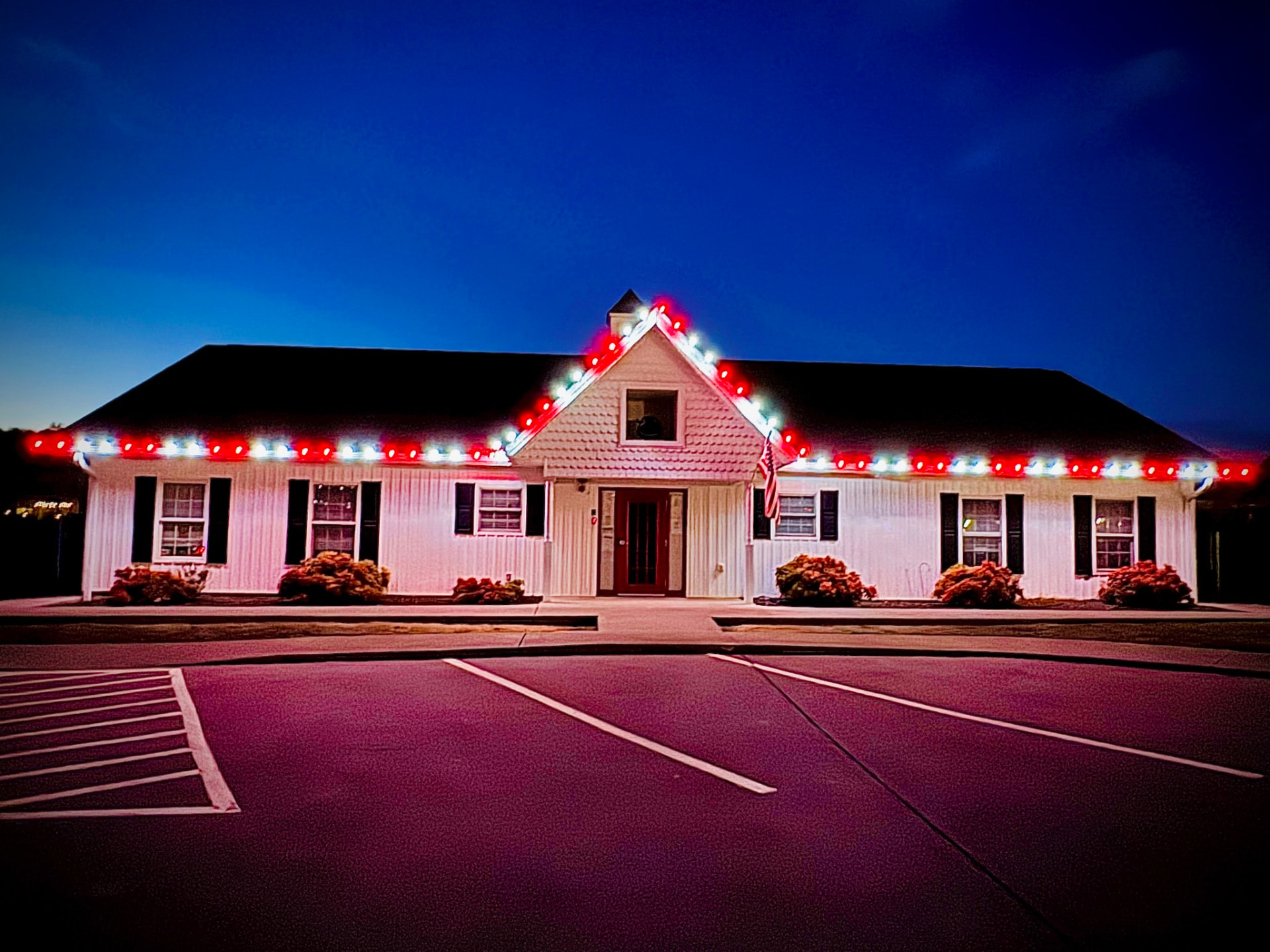
Costs, timelines, leasing, insurance and ROI for commercial Christmas light installation at retail centers, restaurants, offices and HOAs.
What commercial holiday lighting actually costs
Most business owners want a number before they want a design. For a single-story retail storefront or restaurant with a straightforward building perimeter, a leased seasonal display in the Maryville and Knoxville market typically starts in the $1,500 to $4,000 range. Multi-tenant centers, hotels, dealerships and office buildings with lift-access facades or parking-lot tree lines commonly run $5,000 to $20,000 depending on scope.
The number is driven by four things: linear footage, facade height and access equipment, how many secondary features you light (monument signs, tree lines, columns, light poles, planted beds), and how long the display stays up. Bulb cost is a small fraction of any commercial bid — labor and access equipment are the real drivers.
Because we lease rather than sell, that price includes the equipment itself, so there's no capital purchase to depreciate and nothing sitting in a storage room in February.
Leasing versus buying for a business
Buying a commercial display means paying for product up front, paying labor to install it, paying someone to troubleshoot failures during your busiest weeks, and paying again to store and inventory it for eleven months. Two seasons later, roughly a fifth of the strands are dead and nobody on staff wants to own the problem.
A lease turns that into one predictable seasonal operating expense. We own the product, we replace bad bulbs and failed strands free of charge, and we store everything labeled to your property between seasons. For most finance departments that is easier to approve than a capital request, and it's easier to budget year over year.
It also protects the look of the property. Leased displays get retired and replaced on our schedule when color temperature drifts or wire jackets age, so year five doesn't look worse than year one.
The commercial timeline: when to start
Start the conversation in July or August. Commercial bids move through more approval layers than residential ones — an owner, a property manager, sometimes an HOA board or a corporate facilities team — and that approval cycle is usually the longest part of the process, not the install.
Design and measurement happen in late summer. Materials are ordered and custom-cut in September. Commercial installs run from late September through mid-November, because most retail and restaurant clients want the display live the week before Thanksgiving to capture the full shopping season.
Takedown is scheduled to your calendar, not ours. Some retailers want lights down the first week of January; others keep them through a post-holiday sale event.
Installation that doesn't interrupt operations
Commercial installs happen before opening, after close or overnight. Crews stage in a section of the lot you designate, work with cones and spotters where lift equipment is involved, and clear the area before your first customer arrives.
For multi-tenant properties, we schedule one coordinated install date so the whole center lights at once instead of looking half-finished for a week while tenants sign off individually.
Insurance, liability and documentation
Ask any installer for a certificate of insurance before they touch your building. A commercial holiday lighting job puts crews on roofs, in lifts and around energized circuits, and if the installer isn't covered for general liability and workers' compensation, the exposure lands on the property.
We carry both, name property managers or ownership entities as additional insured on request, and send COIs directly to whoever your lease requires. We also handle the electrical side properly: circuits are load-calculated, GFCI protection is used on exterior runs, and timers or photocells are set so nothing runs during business daylight hours.
Does holiday lighting actually pay for itself?
For customer-facing businesses, lighting is the cheapest form of seasonal visibility available. A lit storefront reads as open and active on a dark 5pm December evening, when an unlit one reads as closed. Restaurants and retail centers regularly tell us the display drives photos, tagged social posts and walk-in traffic they don't pay for.
For offices, hotels, medical campuses and apartment communities the return shows up differently: tenant satisfaction, resident retention and a property that presents well during the exact weeks prospective tenants tour.
Compared with a single month of print or digital advertising, a seasonal lease covering six to eight weeks of nightly visibility is usually the cheaper line item.
How to compare commercial bids apples to apples
Commercial holiday lighting bids are notoriously hard to compare because installers structure them differently. One quote may be a single flat labor number, another may itemize materials, lift rental and maintenance separately, and a third may quote a purchase price for product plus an annual hang-and-remove fee. Those are three completely different financial commitments even when the headline numbers look similar.
Ask every bidder the same five questions: is the product leased or purchased, is in-season maintenance included or billed hourly, is takedown in the price, is off-season storage included, and is the number locked for future seasons or subject to annual rebid. Once you have those answers written down, the bids become comparable.
Watch for quotes that exclude lift or bucket-truck access on a facade that clearly needs it. That cost does not disappear; it shows up as a change order in November when the crew arrives and can't reach the parapet.
Property types and what each one usually needs
Strip retail and multi-tenant centers usually center on a continuous building perimeter run plus entrance monument and parking-lot tree lines. The design challenge is consistency across tenants with different awning styles and signage heights.
Restaurants light patios, pergolas, entry canopies and street-facing rooflines, since the goal is to look warm and open from the road. Bistro-style café strands over outdoor seating extend usable patio nights well into December.
Hotels, banks and dealerships prioritize the approach: entrance drives, monument signs, flagpole beds and the front facade. Dealerships often want brand-color accents rather than traditional warm white.
Churches, HOAs and apartment communities generally want a strong entrance statement plus common-area trees, with design approval routed through a board or committee before anything is ordered.
Medical and office campuses tend toward restrained, uniform warm-white designs that read as professional rather than festive, which is a legitimate design brief and one we plan for explicitly.
Power, timers and the electrical details most bids skip
Commercial displays draw more than a residential one, and the difference between a display that runs flawlessly and one that trips a breaker every cold night usually comes down to circuit planning done before install day. We map available exterior outlets, calculate load per run, and split circuits so no single receptacle carries more than it should.
Exterior runs get GFCI protection, and connections are staged off the ground where standing water is a risk in a parking lot or planted bed. LED product keeps consumption low enough that most properties can run a full display on existing exterior circuits, but we verify rather than assume.
Timers or photocells control on and off times so lights are never burning during business daylight hours. For properties with extended holiday hours we can set the display to stay on later than dusk-to-midnight defaults, and adjust it mid-season at no charge if your hours change.
If a property genuinely lacks accessible exterior power at a monument sign or a distant tree line, we identify that during the site walk and quote the workaround up front rather than discovering it on install day.
Budgeting across fiscal years and multi-location portfolios
Holiday lighting spend often straddles two fiscal years — design and deposit in one, install and final invoice in another. We can structure invoicing to match your fiscal calendar, which matters for property managers reconciling common-area maintenance charges against tenant contributions.
Multi-location businesses get one agreement, one point of contact and one consolidated invoice across every site, rather than a different local vendor and a different design language in each town. That consistency is worth as much to most brands as the price itself.
Multi-year agreements lock pricing and install week. For a property manager, that removes the annual rebid cycle entirely and turns a recurring project into a renewal line item.
Frequently asked questions
- How much does commercial Christmas light installation cost?
- Single-story storefronts and restaurants typically start between $1,500 and $4,000 per season. Larger multi-tenant centers, hotels and office buildings with lift work and parking-lot tree lines usually run $5,000 to $20,000. Every quote is fixed, itemized and written before work begins.
- Do we own the lights or lease them?
- You lease them. The seasonal price includes commercial-grade product, installation, free in-season repairs, takedown and off-season storage — no capital purchase and nothing to store on site.
- What happens if lights fail during our busiest week?
- We fix it free of charge and prioritize customer-facing businesses. Commercial accounts get a faster response window than the standard residential schedule, and repairs can be done after close so customers never see a crew.
- Can you match our brand colors?
- Yes. Beyond warm white, we can specify colored bulbs or RGB-capable product to match brand palettes for dealerships, banks and franchise locations.
- When do we need to book to have lights up by Thanksgiving?
- Contract by early October. Commercial calendars in Blount and Knox County fill by mid-October, and starting bids in July or August leaves room for internal approval.
- Can you light multiple locations on one contract?
- Yes. Multi-location businesses and property portfolios get a single agreement, one point of contact and one consolidated invoice across all sites, with consistent design and install timing at each.
- Do you provide a certificate of insurance?
- Yes, and we send it directly to your property manager or ownership entity, with them named as additional insured if the lease requires it. We carry general liability and workers' compensation.
- Will the display raise our power bill much?
- Very little. Commercial-grade LED product draws a fraction of what incandescent strands used, and timers or photocells keep the display off during daylight hours. Most properties see a modest single-digit increase for the weeks the display runs.
- Can you work around a corporate approval process?
- Yes. We provide an itemized written quote plus a simplified one-page summary for owners, boards or facilities teams, and we hold the design and install week while approval is routed.
Ready to light your Maryville property?
Get a free on-site design consultation and a fixed written quote. No obligation.